It's Not Just Your Imagination—Kids Have Changed
Zippo elicits an eye gyre faster from students (and younger teachers!) than a conversation that starts with "dorsum when I was in school…" because it'due south a fact that our students live in a very different world than the one in which we grew upwardly, cheers to applied science. Only it'south also understandable that information technology tin can be frustrating, especially for teachers who've been around a long time, when students don't respond to our tried and true methods.
There'south one thing educators need to hold on, and it's the reality that we must root our education in the fast-paced earth in which our students live, with an center to the skills they will need to succeed in the future. And clinging to sometime norms and teaching methods just isn't going to cut it.
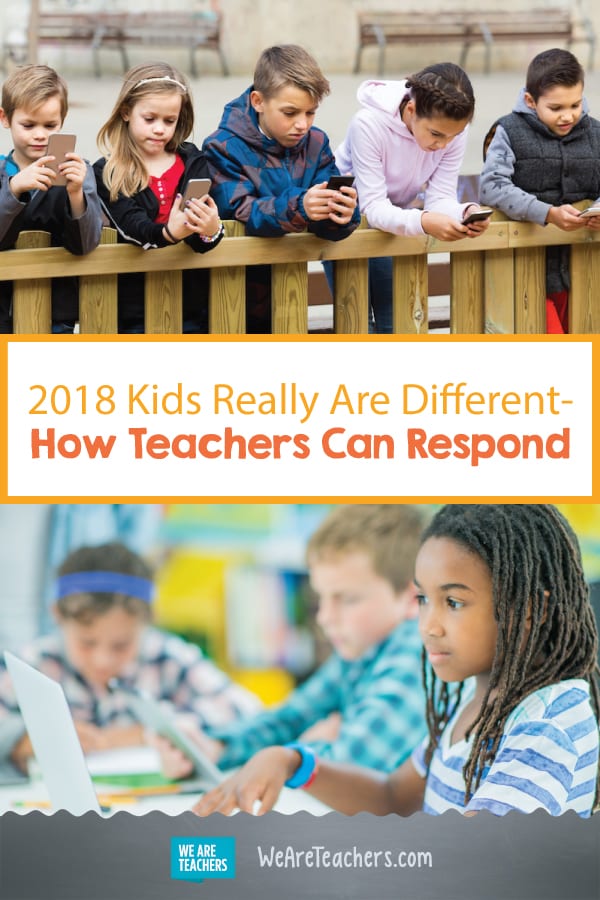
Hither are iii facts near our students that nosotros demand to take into consideration as we think near the all-time way to shape our instruction.
1. There is an infinitely greater amount of information available to our students than we ever had to deal with.
Think nearly it, you tin find the answer to any question you accept about practically whatever topic in the world in seconds via applied science. The problem is, there's SO much data available, it tin can be overwhelming. How exercise you discriminate betwixt what'south important and what'due south fluff? What's true and what'due south baloney? How do you know what sources to trust and where to wait for proof? Learning to evaluate and prioritize information quickly and efficiently is one of the well-nigh important life skills we will ever teach our students.
In improver, with the landslide of information bachelor, it may seem to our students similar everything's already been said. Our challenge is to teach them to sort through and use the best information to create original works and solve problems in innovative ways.
two. Access to and then much information can lead to a tendency to skim the surface.
The concluding thing we want is for our students' knowledge of the world to be a "mile wide and inch deep", so to speak. Nosotros need to help our students build their muscles (and tolerance) for sticking with a problem and dig deeper—to push button them to become beyond instant gratification. We must provide direct instruction for methods and strategies that encourage focused problem-solving. To teach our students to not just rely on what'south already out there, but to enquire the next big question and approach problems from unlike perspectives.
3. Being continued to technology tin can take precedence over connecting in person.
A quick survey of social media these days reveals a growing identification with being an introvert. Well, no wonder. Applied science makes it like shooting fish in a barrel for people (and we're not only talking most students hither) to get a bsorbed in their own earth, picking and choosing to identify with ideas and opinions that already jibe with who they are. Problem is, the connections we brand through technology are not e'er the most authentic. And how practice we grow equally humans if we always stay in a homogenous safe zone?
It's imperative for teachers to build structured social interaction into classwork to teach kids how to make real connections, even if they get pushback—"We hate group piece of work!" Negotiating the real world means working with and being open to other people's ideas and opinions. Building collaboration and teamwork into the curriculum may take some students outside of their comfort zone, but if it has to be forced, so be it. They'll thank the states later.
Bottom line:
Possibly our students don't have the aforementioned attention span that we did, simply they know how to practise incredible things that weren't fifty-fifty invented when we went to school. Possibly they have a harder time working collaboratively, but they all take so much to bring to the tabular array. Thursdayeastward reality is we can't teach the same fashion we learned. That does a disservice to our students and leaves them ill-prepared for the time to come.
How practise you call up kids have changed? Come up and share in our WeAreTeachers HELPLINE group on Facebook.
Plus, hilarious truths only veteran teachers understand.
Source: https://www.weareteachers.com/kids-have-changed/
0 Response to "It's Not Just Your Imagination—Kids Have Changed"
Postar um comentário